
Why Clutter Hits Differently When You Have ADHD
The ADHD declutter daily routine is one of the most searched topics for good reason – people with ADHD are three times more likely to struggle with clutter than those without it.
Here’s a quick-start answer for managing daily clutter with ADHD:
- Define your “bare minimum clean” – clear walkways, no overflowing trash, one clear surface
- Use 10-15 minute timed sessions – stop when the timer ends, no exceptions
- Pick one small area or category – never the whole room at once
- Stack cleaning onto existing habits – do dishes while coffee brews
- Build in missed days – the routine should expect imperfection, not punish it
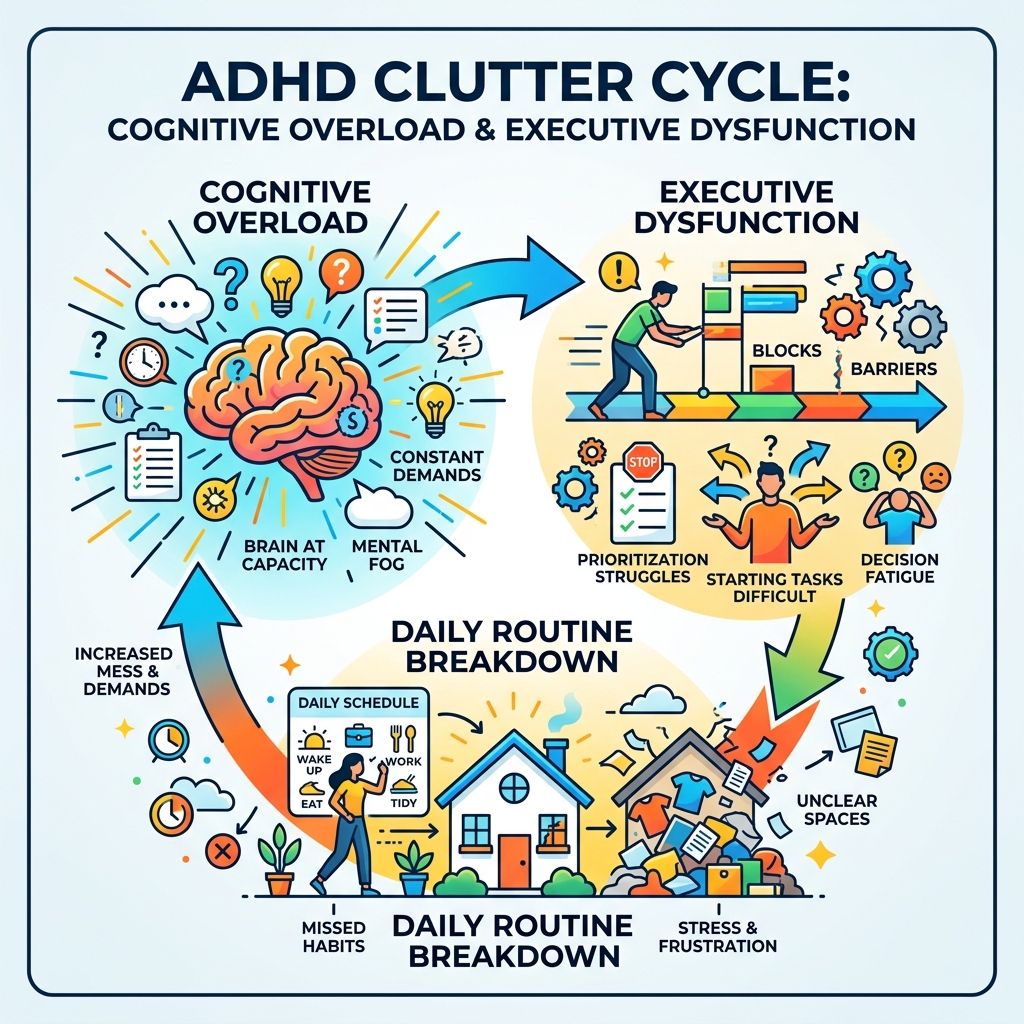
Clutter isn’t just a visual problem for ADHD brains. It’s cognitive overload.
Every pile on the counter, every stack of unread mail, every item without a home – these are active demands on a brain that’s already running at capacity. For busy parents and professionals, this creates a draining cycle: the mess makes it harder to focus, and the lack of focus makes the mess grow.
The frustrating part? Most organizing advice simply doesn’t work for ADHD brains. Standard checklists, rigid schedules, and “just spend a weekend on it” advice all assume a level of executive function that ADHD quietly undermines every single day.
This guide is different. It’s built around how your brain actually works.
Why Traditional Organizing Fails the ADHD Brain
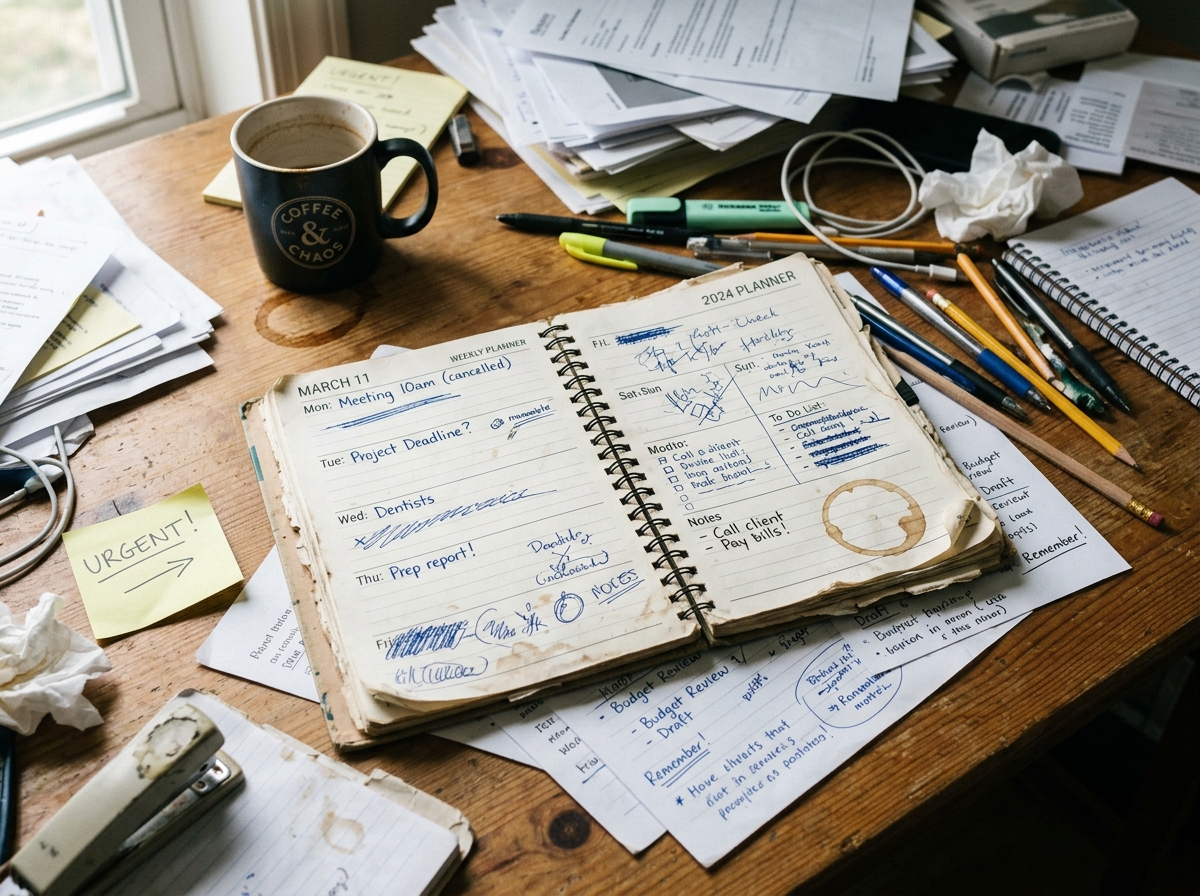
We’ve all been there: we buy the beautiful floral planner, the color-coded stickers, and the heavy-duty storage bins, swearing that this Monday will be the start of our new, organized life. By Wednesday, the planner is buried under a pile of mail, and the bins are sitting empty in the hallway.
Traditional methods often fail because they rely on consistent executive function—the very thing ADHD impacts. When we try to Conquer Clutter: A Step-by-Step Guide for Adults with ADHD, we aren’t just fighting a messy room; we are navigating a brain wired for novelty, not repetition.
The Executive Dysfunction Wall
Executive dysfunction makes it incredibly hard to plan, prioritize, and initiate tasks. For a neurotypical brain, “cleaning the kitchen” is one task. For an ADHD brain, it’s a terrifying explosion of thirty different sub-tasks: Where do the spices go? Should I soak this pan? Oh look, a cool magnet I forgot about! This leads to “task paralysis,” where we end up staring at the mess, unable to move.
Time Blindness and Perfectionism
Many of us struggle with “time blindness,” either underestimating how long a chore takes (thinking we can clean the whole garage in 20 minutes) or overestimating it (feeling like doing the dishes will take four hours). Combined with perfectionism—the “all-or-nothing” mentality—we often feel that if we can’t do it perfectly, it isn’t worth doing at all. Learning to create ADHD-Friendly Decluttering: Creating Stress-Free Spaces means accepting that “good enough” is a massive win.
The Science of the ADHD Declutter Daily Routine
To make a routine stick, we have to lower the “activation energy” required to start. In ADHD, “out of sight is out of mind.” If our cleaning supplies are tucked away in a dark basement, we will never use them. If our schedule is hidden inside a closed book, it doesn’t exist.
| Feature | Traditional Routine | ADHD-Friendly Routine |
|---|---|---|
| Structure | Rigid and time-stamped | Flexible and energy-based |
| Task Size | Large blocks (e.g., “Clean House”) | Micro-tasks (e.g., “Wipe one counter”) |
| Visibility | Hidden in apps/planners | Visual cues and open storage |
| Approach | Discipline and willpower | Systems and dopamine rewards |
By focusing on Daily Habits to Maintain Tidy Spaces, we move away from the “panic-clean” cycle (where we only clean when guests are coming) and toward a sustainable flow. These Routine Hacks to Prevent Clutter are about working with your brain’s natural rhythms.
Establishing Your “Bare Minimum” ADHD Declutter Daily Routine
One of the most powerful tools in our arsenal is the Minimum Level of Neatness (MLN). This is the baseline that keeps your home functional and your guilt at bay. Your MLN might be:
- All trash is in the bin (not on the floor).
- The kitchen sink is clear of food scraps.
- There is a clear path from the bed to the door.
When your energy is low, you only do the MLN. This prevents the “spiral” where a small mess becomes an insurmountable mountain. For more on this, check out The 20-Minute Method for a Streamlined Home Routine.
Building Flexibility into Your Schedule
The biggest killer of an adhd declutter daily routine is the shame we feel when we miss a day. We need to build “failure” into the design. If you miss Tuesday, you don’t “make it up” on Wednesday by doing double work; you simply start again on Wednesday. Categorizing tasks by energy levels (High, Medium, Low) allows us to pick a “Low Energy” task like “sort one mail pile” when we are feeling drained, rather than abandoning the Weekly Home Maintenance Routine entirely.
Strategies to Gamify and Simplify Your Space
ADHD brains crave dopamine. Cleaning, unfortunately, is notoriously low in dopamine. To bridge the gap, we have to make it a game.
The Power of External Motivation
- Visual Timers: Using a physical timer that shows time “disappearing” helps combat time blindness.
- Body Doubling: This is a game-changer. Simply having someone else in the room (or on a video call) while you declutter provides the external “anchor” your brain needs to stay on task.
- Dopamine Stacking: Only listen to your favorite “guilty pleasure” podcast or audiobook while you are cleaning. Soon, your brain will look forward to the activity.
For a deeper dive into these visual strategies, see our Visual Approach: A Guide to Decluttering for ADHD. If you’re in a rush, try Lightning-Speed Decluttering: Organize Your Home in 30 Minutes.
Using Micro-Tasks for a Sustainable ADHD Declutter Daily Routine
The secret to avoiding overwhelm is the “One Shelf Rule.” Never try to declutter the whole kitchen. Instead, declutter the spice rack. That’s it. Success!
We also love the OHIO Method: Only Handle It Once. When you pick up a piece of mail, don’t put it in a “to deal with later” pile. Decide immediately: Trash, File, or Action. This reduces the “decision fatigue” that leads to clutter piles. If you’re just starting out, our Decluttering for Dummies: A Beginner’s Step-by-Step Guide can help you break these down further.
Theme Days and Category-Focused Approaches
Instead of a generic “cleaning day,” try theme days to simplify your choices:
- Monday: Paper Reset (Mail, school forms, receipts).
- Wednesday: Clothing Check (Find one thing to donate, start one load of laundry).
- Friday: Digital/Workspace Reset (Clear the desk, delete old downloads).
This category-focused approach prevents you from wandering from room to room, getting distracted by different types of messes. It’s a core part of How to Tackle Decluttering with ADHD: A Comprehensive Guide.
Essential Tools: Planners, Labels, and Visual Aids
For us, “Out of Sight, Out of Mind” is a literal neurological reality. If we put our pens in an opaque drawer, we will buy new pens because we forgot we had them.
Visibility is Key
- Clear Bins: Use transparent storage so you can see exactly what is inside.
- Label Everything: Labels aren’t just for aesthetics; they are “external memory.” They tell your brain exactly where an object lives so you don’t have to use precious mental energy to decide. Check out Creating an ADHD-Friendly Cleaning Routine with Labels.
- The “Catch-All” Basket: Have one basket in each main room for things that don’t belong there. Once a week, walk the basket through the house to return items to their “homes.”
Choosing the Right Planner
There is no “perfect” planner, but many in the ADHD community find success with Horizontal Weekly Layouts that stay open on the desk. Digital tools like Google Calendar are great for appointments, but physical Habit Tracker Ideas for Clutter Control often work better for daily chores because they provide a tactile sense of accomplishment when you cross something off.
Structuring Your Day: Morning, Evening, and Beyond
A successful adhd declutter daily routine isn’t a separate event; it’s woven into the fabric of your day through “habit stacking.”
The Morning Reset
Your morning routine sets the tone. Instead of a 50-step process, focus on “Closing the Loops” from the night before.
- The 5-Minute Surface Sweep: Clear the kitchen island or coffee table.
- Start the “Machine of the Day”: Whether it’s the dishwasher or the laundry, get one automated task running. Find more focus tips in our ADHD-Friendly Morning Routine Tips for Focus.
The Evening Wind-Down
The goal of the evening is to make “Tomorrow You” happy.
- The Launchpad: Lay out your keys, wallet, and bag in a designated spot.
- 10-Minute Tidy: Set a timer and put away as many “homeless” items as possible.
- Dish Zero: Aim for an empty sink before bed. It makes a world of difference for morning clarity. See our Evening Routine to Stay Organized and Time-Saving Routines for Busy Homes for more ideas.
Managing the Aftermath and Preventing Burnout
The “ADHD Explosion” is real. We start decluttering a closet, get distracted, and two hours later, the entire contents are spread across the bedroom floor while we are looking through old photo albums.
The Cleanup Phase
Always leave 20% of your allotted time for the “Aftermath.” If you have 30 minutes to declutter, stop at 24 minutes. Use the final 6 minutes to:
- Put the “trash” bag in the outside bin.
- Put the “donate” box in the car trunk immediately.
- Wipe down the surface you just cleared.
Positive Reinforcement
Our brains are starved for positive feedback. We often focus on the 90% of the room that is still messy rather than the 10% we just cleaned. Celebrate the small wins! Take “before and after” photos—they provide the visual proof of progress that our working memory often forgets. This shift in Mind Over Mess: Decluttering for Mental Clarity is essential for long-term success. You are Decluttering for Success: Increasing Focus Through Organization, not just for guests.
Frequently Asked Questions about ADHD Decluttering
Why is decluttering so hard for adults with ADHD?
It’s a “perfect storm” of executive function challenges. Decluttering requires constant decision-making (Keep? Toss? Donate?), prioritizing, and emotional regulation. Because we often feel a strong emotional attachment to objects (“I might need this for a project someday!”), we suffer from “decision fatigue” much faster than others.
What is the “one-in, one-out” rule?
This is a simple boundary to prevent “clutter creep.” For every new item you bring into your home (a new shirt, a new kitchen gadget), one similar item must leave. This forces a moment of mindfulness before a purchase and keeps the total volume of “stuff” manageable.
How do I handle sentimental clutter without spiraling?
Sentimental items are the “final boss” of decluttering. Don’t start with them! Build your “deciding muscles” on easy things like old Tupperware or expired spices first. When you do tackle sentimental items, use the “Trunk Test”: put them in a box in your car for a week. If you don’t think about them or miss them, they are ready to be donated.
Conclusion
At Educacao Play, we believe that an adhd declutter daily routine shouldn’t feel like a second job. It’s about creating a sanctuary that supports your unique, brilliant, and sometimes messy brain. By moving away from rigid expectations and embracing effortless, practical strategies, you can lower your stress and reclaim your space.
Start today with just one surface. Set a timer for ten minutes, put on your favorite song, and see what happens. You’ve got this!
